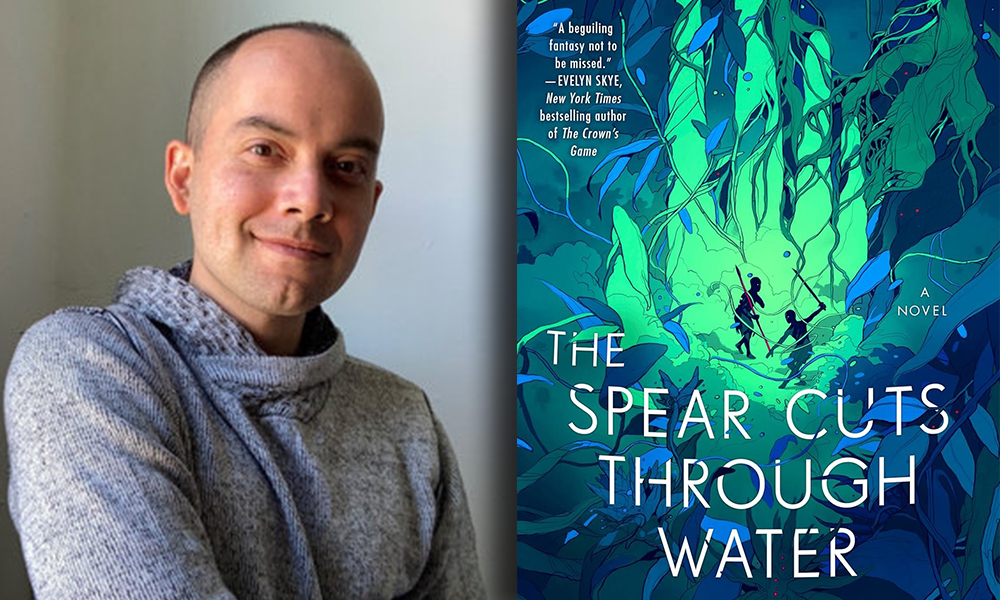
There’s something almost unfair in the number of feats that Simon Jimenez’s The Spear Cuts Through manages to pull off. It is a lush, vivid fantasy that rarely seems to spend any time at all digressing into world-building or lyrical descriptions. It is a rewarding tale of love and tenderness that makes few concessions to romanticism, and is in fact painfully aware that the demands of everyday life leave most of us precious little time for pining. It is a work of art of remarkable complexity, a story about a dream about a dance abound a legend, arguably impossible to fit at once in the mind’s grasp yet evolving on the page in the most natural of ways.
Much of the genius of its intricate construction comes from the novel’s frame narrative, the way its story is conveyed to the reader. The Spear Cuts Through Water is narrated in the second person, with its protagonist (a young man referred to as “you”) reminiscing about the legends of the “old country” that his grandmother used to tell him, usually through a cloud of cigarette smoke, when he was little. Prominent among these stories was that of the Inverted Theater, a wondrous place one might visit in their dreams only once in their lifetime. And it is indeed into the Inverted Theater that “you” wander early in the book, to experience, unfolding on a stage as a dance of incomparable complexity, the tale that makes up the bulk of the novel. A story focusing on the final days of a bloody empire, and on the forces trying to redress some of the evil it has wrought on the word. A tale of great violence and bloodshed, but of redemption and friendship too – and above all, a love story.
In just over five hundred pages, The Spear Cuts Through Water builds an entire universe, with its unique cosmology and mythology, geography and social structures. It is a world that feels, at times, almost too familiar, with its oppressed populace living in terror of a security state scouring their thoughts for signs of treason, expecting absolute obedience and punishing wickedly whoever fails to comply. Yet throughout the misery of these violent times shine flashes of beauty and wonder, be it in the unexpected camaraderie between a group of orphans and a much maligned outcast, or in the colorful plumage of a temperamental yet loyal bird. Its cast of characters is brilliantly diverse in ways that are far from superficial, and each of them can appear at once incredibly powerful and all too easily brought to their knees.
Keema and Jun, young warriors with painful pasts behind them, are the heroes of this story – but their epic journey is interspersed with frequent breaks where the frame narrative comes back to the fore, allowing its protagonist to compare or contrast these warriors’ lives with his (“your”…) own existence. This is a much more humdrum situation: a big family, a difficult father, a stagnant country stuck in a hopeless war. A life not as dangerous as Keema or Jun’s, perhaps, where every twist in the road brings new blades to fend off, sharp fangs to escape; yet also a life without apparent hope or prospects.
It is curious, then, how this frame narrative can sometimes appear even more compelling than the stuff of epic fantasy in the novel’s main storyline. The protagonist’s continuous presence in the novel – which, handled by a different writer, would have been a distraction from the gripping events sweeping up our heroes – allows us to project the dilemmas gleaned from this awesome legend onto an existence that will appear, to most of us at least, more relatable. What can we learn about the nature of power from the forces vying for control of this empire? What is the nature or purpose of guilt, and can redemption ever be truly obtained? How can love come to cause so much violence and turmoil?
The frame narrative in The Spear Cuts Through Water is far from a self-serving, needless device. It becomes more and more apparent as the novel progresses that the protagonist’s connection to the spectacle he is witnessing in the Inverted Theater is far from incidental. The presence, in both frame narrative and epic tale, of an awe-inspiring spear in a prominent position is, admittedly, an early giveaway. The relationship between the “old country” that this protagonist knew through his grandmother’s stories and the land that Keema and Jun are striving to save is played out in beautiful and surprising ways, exploring our connections to our foundational myths, the reasons why people uproot their families and reinvent their lives in faraway lands.
Another marvelous narrative technique that Jimenez can introduce into the novel thanks to his Inverted Theater are the many asides that pepper his tale. As we read Keema and Jun’s story, we should imagine it conveyed through an intricate, elegant dance; one where the dancers on the sides of the stage can also contribute their own steps, offering a commentary to the main narrative that works in much the same way as the chorus in a Greek play. See an example of how this works in the passage that introduces Araya, one of the most enigmatic characters in the book:
Titles were hard to shake in those days. They branded a person as sure as a hot iron on a flank. Some titles were cultivated. They offered a kind of protection, social or otherwise, to those who wore them, whether that be as a warning or a feint. So it was for the commander of Tiger Gate Checkpoint, Uhi Araya, who was known in most circles of the military hierarchy as Araya the Drunk. The Lady of the Flask. The Blushing Fiend. Our Stumbling Maiden. A jovial woman of short, round stature, a creature of her comforts who achieved her success despite, or in some cases because of, her reliance on the drink, becoming in short order the overseer of the first checkpoint that lay on the infamous Road Below. A powerful position that yielded many benefits for her. We always wondered how she got where she was—what connections she had. Her reputation preceding her as someone quick to laugh, and quicker to offer a swig of something debilitatingly joyful even while she took bribes on the side and bumped up the taxes of those passing through her checkpoint on larks and whims. She said she didn’t like the look of me. And then she turned us back. She didn’t even return our papers. This was Araya.
The asides in italics grant us access to multiple perspectives on this character, her actions, and her reputation. The profuse and creative use of this technique throughout Spear makes its world feel truly alive, richly inhabited by a diverse array of experiences. It also means that the novel, unlike much epic fantasy, doesn’t feel like a simple clash between superheroic, larger-than-life “chosen ones” in a world peopled by flat extras. Here, the common people get their say, too, even if it’s only a handful of words.
The more fantastical elements of the plot might feel like a big departure from the realism of its grimmer aspects (this is a world where the moon fell from the sky at some point in the recent past, supposedly landing on a turtle’s back) but this, too, contributes much to the novel’s atmosphere of awe, its challenge to the expectations of fiction fantastical or not. The world of Spear feels vividly exotic – though in truth large swathes of it are left to the reader to imagine as they please – but never orientalist; different from the canon of medieval fantasy, without making a flamboyant show of the way it draws from folkloric traditions outside of Europe and Japan.
The Spear Cuts Through Water is an incredible performance, a story that is at once comforting and nourishing, wise and passionate. A tale that delivers on many of the familiar comforts of epic fantasy – its ravenous monsters, its temperamental heroes – but eschews some of the genre’s simplistic pitfalls. Every development in this story brings along more complexity; this is not a fight between absolute good and evil, but a quest to see if a modicum of balance can ever be reintroduced into a fundamentally broken world. With its uniquely intricate and beautiful frame narrative, it calls to mind a short story by Cortázar or a novel by Calvino, while remaining very much an original creation.
It is said that dreamers can only visit the Inverted Theater once, and never come back. We should thank our lucky star, then, that during our brief time there we get to experience the performance of a lifetime.