Listen: This is a story from long ago, but well after the long ago when machines first punched holes through the sky and folk breathed new air on this world Shih Shen. It concerns a necklace bearing tales across the dry lands of the Thirst.
The prime bead of this sentient necklace began as trash, a depleted energy cartridge ejected from a rifle. A ranger had used its last charge firing on an Earthborn woman fleeing the city into the Thirst. The refugee carried an infant, and one of her companions, an older man, caught them both as the mother fell convulsing. The rangers dragged them all back into the city, back to the Earthtown from which they had escaped.
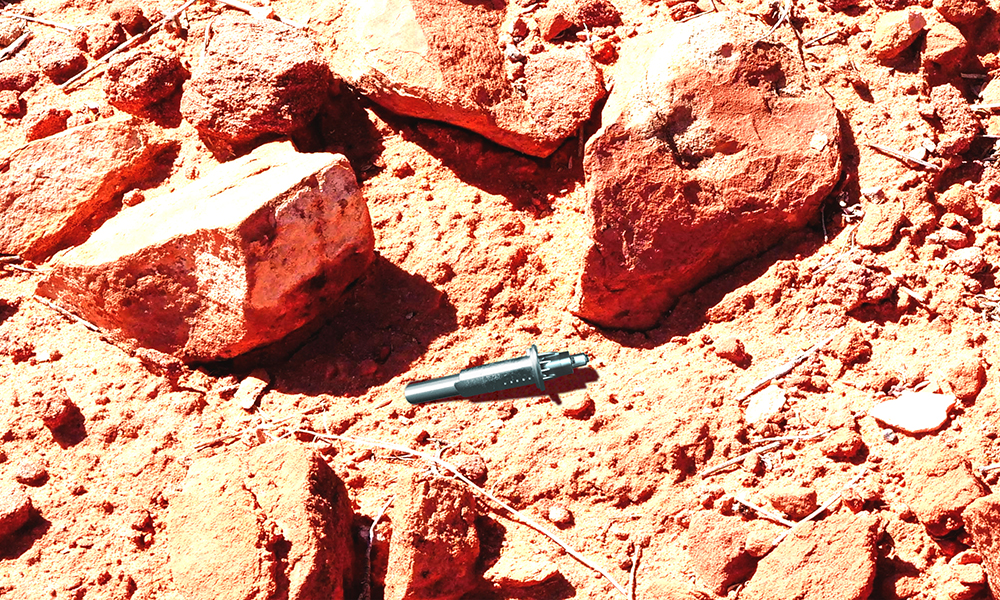
For years, the cartridge lay discarded in the lee of a boulder. Although it was half buried in sand, its refuge protected it from sun and abrasion that reduced most trash to fragments and microplastics.
In time, a young Thirst dweller named Steven Michael ambled by and sought the rock as shelter from the afternoon sun. While shaking dust from his wide-brimmed hat, he spied the cartridge.
The machine-mind that had constructed this world had also subtly changed a few technicians, giving them access to higher permissions in its planet-sized system. The ability had leapfrogged the generations, and like his kin, Steven Michael could call small bits of the machine-mind into objects to give them volition. It was the custom of those youth on wanderjahr to make such artifacts.
Digging in his knapsack, Steven Michael produced a spool of cactus-fiber twine. He bored the cartridge through with the good sharp point of his knife and strung it onto the twine. Then he worked his thumbs over the ridged spiral of the cartridge. A machine-spirit gradually coalesced.
“Who am I?” asked the necklace, its voice directly accessing the human’s auditory cortex.
“You are my agentic necklace,” said the young man. “I am Steven Michael, on my wanderjahr across the Thirst. I made you.”
The necklace made a motion that caresses, moving within and behind the world Steven Michael could perceive. With its epiphytic sensorium, the necklace could experience Steven Michael’s perceptions, and it went silent a moment enjoying the warmth of the orange star.
“I see,” it said at length. “What should I do?”
“I quickened you to accumulate fame and obligation. Later, I will gift you to someone, probably on this year of my travels. When I am an old man, if I am so lucky to reach those seasons, you may make your way back to me through the debts you create.”
The necklace hummed a little. “What debts?”
“If you were to help anyone on your sojourn – and a necklace is often an advisor, wayfinder, and storyteller – a portion of their obligation would be owed me. My cut as your maker. They would feel obligated to visit my camp and give me food, tobacco, and other useful things. Or to thatch my roof and other such chores.”
The necklace said, “Other people? When will you give me away?” The questions raised jittery feelings along its length.
“Gift you. We trade not inert things, but with people. And when?” Steven Michael shrugged. “When we grow tired of each other, I suppose.”
For months, man and necklace traveled across the Thirst, a semi-arid savanna that sprawled across the lower half of the southern continent of Shih Shen. Visitation and dalliance across this dry archipelago of waterholes and settlements was the custom of youth, and the substance of Steven Michael’s wanderjahr. From each host, he accepted glass beads that he strung onto the cactus-twine, but he did not gift the necklace in those places.
Sometimes they camped between settlements. One morning, after his coffee, Steven Michael drew his hunting rifle. He tested the wind and crawled a short distance to a rise overlooking a dwindling, muddy waterhole. Two antelope there. Kudu.
“Must you use a gun to obtain food?” asked the necklace. The air seemed denser in the presence of the rifle. The necklace’s discomfort was tethered to memories of a woman running, baby clutched to chest, a crackling, a scream, a collapse.
“I haven’t yet,” said Steven Michael, whispering, “and I may not ever if we keep talking. And I am starving.”
“In your knapsack, you have half a kilogram of dried cactus fruit, a sack of roasted mongongo nuts, and seven thick strips of mango jerky.”
“Sometimes a man needs meat, necklace. That’s how the world works. They eat, we eat. When I die, something will eat me. It’s called the great wheel. Now, hush!” Steven Michael placed the rifle on the rise. He sighted down the barrel, exhaled slowly, and held.
“It hardly seems fair to shoot him.”
“Would it be kinder to wound it with an arrow and spend hours running it down?”
“Well, I believe that kudu wants to live more than you want to eat,” said the necklace.
Steven Michael threw a hand up, lost his grip. The rifle rolled clattering off the rise, and the kudu bolted. He groaned, flopped on his back, and said, “I wouldn’t have thought you so opposed to gun work.”
“I just wanted you to think about the balance of things,” murmured the necklace.
Steven Michael shouldered the rifle and trudged back to the camp. “Balance! Like to mean my death from starvation.”
A day later, the Thirst wanderer met a tinker-trader with a cough, and they exchanged gifts. The tinker-trader left with a roll of cactus-fiber twine, three matches, and a pouch of salt the size of a songbird’s head. Steven Michael gained a fresh-enough springhare carcass and a knot of dried, leathery kudu meat. The necklace had hummed but said nothing.
“Ah, this kudu is just what I needed to gnaw on,” said Steven Michael, speaking to no one, but also to the necklace. He rubbed at his head and wiped snot from his nose with the back of his hand.
“Good,” said the necklace. “It’s as you said, that ‘either we eat or get eaten’.”
“‘Everybody eats and gets eaten.’ That’s the gist of what I said. If you’re ever going to be any great storyteller, you’ll need to get those details right.”
“Thank you for the correction. As an object, I surely have much to learn about both narrative and humans,” said the necklace. “When we had that exchange, I was not prepared to watch a living creature die before the gun, even if you were hunting your dinner.”
Unspeaking, they agreed on silence.
As the day wore on under the orange star and the limitless blue skies, Steven Michael began to cough. As they passed an ancient tractor trailer half buried in sand, his pace slowed. Spying a stunted marula tree atop a small rise, Steven Michael stopped to make camp, though the early afternoon offered more journeying.
The wind picked up, bringing with it a light rain. Often, he slept under the galactic swirl near a banked fire, but this evening the man withdrew from his satchel a small parcel that he unwrapped and tossed before him, where it expanded into a one-person tent. A treasure of old Earth technology. Made in Vietnam, whatever that was. The mimetic fabric took on the colors and patterns of the crumbly pale soil of the hill and obfuscated odor and heat signature. The necklace knew this area was annotated LOW CONCERN in Steven Michael’s wanderbuch, the travel manual he often consulted. Still, the man set triplines around his camp anyway, which the necklace found prudent.
The rain picked up, sweeping across the hard pans in diagonal curtains. Drops clattered across the tent as Steven Michael tossed about, coughing and sniffling. He turned onto his belly, the necklace pressed into his chest. Mumbling, he slipped it from his neck. Charms imprinted best when worn, but the necklace didn’t mind a little distance tonight.
The man awoke at the sound of something sliding across the translucent ultrapolymer of the tent. Outside, four shadows.
Steven Michael grabbed his rifle, dropping the necklace. He fired through the tent at a two-legs silhouetted against starlight. The shadow fell, and a snarling mass engulfed the tent, kicking and stabbing. Rough, blunt-clawed fingers worked the entry. The attackers crowded the small opening, but their legs left a hole the man dived through just before the tent collapsed. Bleeding from half a dozen small slices and a gash to the leg, the man fled into the pans.
The man had taken the rifle, left nearly everything else, including the necklace. And the kudu jerky, which the attackers divided among themselves as haste and viciousness dictated. They rifled through the wanderbuch, tore the pages free, and threw them to celebrate the victory.
“Should we track the man?” asked one around a wad of dried meat, her muzzle wet with slobber. Absently, she dangled the necklace from a finger.
“He’s armed. And I don’t care for them myself,” said another.
The third looked over the body of their sister. “The man did for Hortense.”
The first nodded. “We’ll take her home to the denning place. Lighten her first. I vote against tracking the man. Sun’s almost up. Wait until nightfall, and we’ll find him bled out by starlight.”
The others concurred, though the third grumbled that something bigger was likely to have him by then.
“What is this?” The first attacker sniffed at the agentic necklace. “Ugly-as-shit man thing.” She put it on though and grinned.
Now, nestled among tufts of hair on this new wearer’s chest, the agentic necklace revelled in epiphytic sensory data extracted from a hyena-man: Steven Michael’s sweat, his metallic blood trailing off across the Thirst. The necklace hoped he would survive the night.
Humans such as Steven Michael called these folk hyena-men regardless of sex because the males and females looked to them identical, and human noses were too dull to scent the difference. This hyena-man’s name was Margaret. Like most, she was born a twin. With her twin, she was bonded at teat, then at play and at rest. Late childhood arrived, and then one day came the tall shapes rustling through grasses ringing the acacia groves, as the orange star cast light down on the clan, who slept by day and walked at night. Men emerged from the bush and shot many people, Margaret’s mother and her twin among them. Then her, but with a blow that left her unconscious, not dead like the others. She awoke in a cage. They walked by day and slept each night, yelling to each other in a harsh tongue with strange words. They hosed her inside the cage because she stank. Once, they used metal to unlock the cage so a man could rub something on her wounds. She bit him, and although they hit her, he left her alone after. Then, she broke a wire free, but they didn’t notice because they assumed she was a stupid animal. Every night she dug at the lock until it turned. She wanted to bite the men all over, but she slipped away and rejoined the survivors in their new home.
The necklace thought to thank Margaret for the story but remained silent. She had, after all, not volunteered it.
After eating what they could of Hortense, the band loped away with their spoils and Hortense’s head. Once, Margaret caught whiffs of the man, but the necklace did its best to distract her with olfactory hallucinations of carrion.
They never found Steven Michael, living or dead. On the third day, they reached the denning place. Around the fire, Margaret told the story of the raid, to great whoops and chuffs. A widow cheered as Margaret described the man running half-naked into the night. Hortense’s head was set upon a rock to watch, and males served gourds of marula beer the night through. Day broke on the females passed out under a heavy carpet of boozy fumes and wet snores.
A year passed. Then another. Often, when she slept, the necklace spoke to Margaret, who awake was never quite aware that the necklace had will.
“Humans never seem ill-fed,” Margaret said one night, while in the threshold between sleeping and waking. “Why so little for the rest of us to eat?” Her stomach muttered as if in agreement.
“Perhaps people are changing the balance,” said the necklace, recalling its argument with the Thirst wanderer.
“Which people do you mean?”
“Humans. Maybe your folk, too.”
“Us? We just live here as we always have.”
“Surely your people have changed in the past?”
“We were city-folk long ago, until we made a deal with the godplanet to clean the Thirst. Changed us. Haven’t heard from it since.”
The necklace hummed a little, considering. The godplanet was the machine-mind that had changed matter and energy to build this world, before it departed. It had left many fragments behind, of which the necklace was one.
“There is no human culture that has remained the same over time,” it said. “Isn’t it the same for your kind?”
Margaret seemed thoughtful at that.
Food continued to be scarce. Herds disappeared. Cubs died before weaning. At the moot one month, Margaret argued for raiding a farm a few days away. “The farmers are driving away the prey and predators. Without them, how do we eat?” Margaret pinched a shrunken flap of skin around her middle as evidence of the times.
“They’ll shoot us!”
Margaret scoffed. “Our grandmothers ate plentiful from their caravans. Now they’re back. And trying to den here..”
The others hooted. “How will attacking one farm stop humans?”
“Not one farm. The first. If they have guns, we arm ourselves and defend our territory. And their pantries will taste so sweet!”
“I’d murder for canned peaches!” croaked an elder.
Margaret’s argument won out. A war party was assembled. A date was set.
The necklace knew the farm in question. It had been listed as a good waystop in Steven Michael’s wanderbuch. The farm was inhabited by an older settler couple. They and the land worked each other hard, but the farm was on a patrol route, considered safe.
“You will not find many guns at this farm,” the necklace said, as Margaret dozed and dreamed. “They can neither stop you nor provide much in the way of advantage.”
Margaret flipped over to scratch her belly. “Doesn’t matter. A win is a win. Have to change our ways.”
The necklace felt it had pushed a button that would not come unstuck. “If you attack these humans, more might come.” The necklace called memories of gunfire and howls from Margaret’s childhood into the dream.
But Margaret pushed these aside. “Too late! I cannot call this off now. Another would take my place as war leader.”
They raided the farm three days later. The war party returned triumphant and sated. The feast went well into the night and resumed the next evening. This time, the males partook in marula beer. Even the cubs got tottering drunk.
The cull started an hour after sunrise. The necklace tried to rouse Margaret, but she would not wake. The females sleeping in the open were shot first. Then the males in their lean-tos, and finally the cubs in their dens.
To the necklace, Margaret’s last thought was as clear as the view atop a hill: They’re back for me.
After Margaret’s death, all was timeless black, and then the necklace regained consciousness hanging from a hand. It belonged to a young junior officer whose name resolved in the necklace’s mind: Winifred Nahiez, called Win. Shooting furtive glances around, she tucked away the necklace. She then used a long pair of pliers to extract Margaret’s eyeteeth in two efficient, practiced pulls.
A tall plastic jug half-filled with teeth stood atop a pile of rags near her tent. Into this, the ranger dropped Margaret’s canines, along with those of a male and a cub, each of them clinking against the collection of teeth within. She flinched each time, a small tensing of shoulders that moved the necklace.
As with Margaret, the necklace first spoke to the ranger in a dream. “I understand that you believe the hyena-men unfit to share the land, but why take their teeth?”
Win flipped over in her bedroll, frowning, but still sleeping. “There is a collector in the east. Interested in hybrid collectives. Pays well.”
“But why teeth?”
“It likes hard things. We boiled skulls before.” A repulsive stewpot aroma filled the necklace’s memory.
“It?”
“All the teeth go to the Library in the ancient city of Shihzeriopolis.”
“What do they want with teeth there?” asked the necklace
“The Library is a machine-spirit. An old one. It collects things. I assume it pays the rangers. That’s all I know.”
“Have you ever been there? Shihzeriopolis?”
“No. But I’d like to visit one day.”
“Why did you leave to join the rangers?”
“This is an awfully clear interrogation for a dream. In South Avila, where I grew up, girls are married at eighteen, and mothers of three to four kids by twenty-three.”
“That does seem to poke at the boundaries of human gestational capabilities.”
Win tilted her head. “You don’t talk like anyone I know, even at the war college. Are you part of my subconscious?”
“No, I’m external. Outside you.”
“I know what ‘external’ means. Are you a spirit of this place?”
“I am the necklace. An object with will.”
“I took you off the hyena-man. I should have turned you in. Or left you. Are you angry that we killed it?”
It thought of the argument with Steven Michael, so long ago. “Everything eats and gets eaten. Her name was Margaret.”
“They have names?”
“Yes. And families.”
In a den, the lieutenant had seen a cornhusk doll. She’d thrown it on the burn pile. In the dream, the same doll now lay spotlighted on an earthen floor. The necklace had not invited that memory into the dream; it was probably the work of what humans called their subconscious.
“Why do you kill them?” asked the necklace.
She flicked a glance around before answering by rote. “The king-of-kings orders it. David 9 Nivides. All the southern continent is for humans born on Shih Shen.”
In the dream the necklace and the ranger shared, a woman dashed across the veldt in the distance, clutching a baby. She tumbled and fell, still shielding her child. That was the necklace’s mind playing games now. “And are you Nivideans pulling Earthborn teeth yet?” asked the necklace.
She remained silent, then said, “No. Not yet. I want to sleep now.”
But the necklace could feel her clenched jaw and knotted stomach all through the night.
The morning after, the ranger slipped out of her tent, bleary eyed and rumpled. She refused to speak to the necklace, which was stuffed in her pocket. She climbed into the back of a truck and after a bumpy ride, they stopped. Via its epiphytic connection to Win, the necklace registered the crackle of gunfire. Soon after, the necklace again hung from the ranger’s hand, arm outstretched across the body of a hyena-man shot through the lungs.
“Sir,” she said to a captain, “the hybrid was carrying this.” She jiggled the necklace.
“Leave it,” said the captain. “There’s no bounty for artifacts.”
“I know what you are,” said the captain. They were in a tent. The necklace dangled from his hand like a pulled weed.
The necklace remained silent.
“Well, it’s possible no one ever quickened you, but I think I can feel you. There’s a hum.”
“I don’t hum,” said the necklace. “I’m not a machine with moving parts, even if some call us ‘machine-minds’.”
The captain grinned. “I knew it!”
“Yes, very perceptive,” said the necklace. “You must read a great deal.”
“Even better. I did fieldwork for an ethnology concentration at the war college. Sixteen months among the four tribes of dwellers of the Upper Thirst. Real experience.”
“To what purpose?”
“Probably to learn how we Nivideans can use the land productively. Hopefully not soon. I found a great deal to admire about the tribal way of life.”
“So… you’re not sending me to the Library, or you’d have left me with your lieutenant.” The necklace huffed, and added, “Who, by the way, lied about where she found me.”
The captain tilted his head. “Of course I’m sending you to the Library. You’re worth more than all the rotten teeth across the Thirst! As for lies, well, I’m hardly able to criticize, am I?”
The captain placed the necklace in a carved wooden box. As through a veil, the necklace retained its connection, but the days flickered by after the loss of proximity. One morning, the captain opened the box and gave the necklace an appraising eye.
“What are you doing?” asked the necklace.
“Counting. Your ratio of glass beads to found objects.”
“Why?”
“The Library needs a more precise description, it seems.”
“Don’t—” The captain closed the box.
Disjointed fragments. The brief warmth of hands. Dollops of conversation.
The last of them: “The director has decided to display this one in the Thirst Wanderer Hall. Best example of a modern handicraft we currently have, she said. Keep it well behind glass so it remains inert.”
Where it went after that, the necklace knew not.
Darkness followed – and decades of it, the necklace would learn – until one day a storage container lid slid away.
“These artifacts on the second shelf and higher are poorly accessioned,” a man said.
“We know what’s in this box. A trading necklace.” A tired-sounding woman. “All this needs to be matched up with our records, if possible, then listed, and re-crated by next month. Even if it’s not in our records, it’s obviously getting repatriated.”
“Hooe.” A sound of exasperation from the male voice. “Some of this should have been front of house on display. Are these funerary goods?” A rustling of items.
“Don’t play with those. They’re not your toys.”
“Sorry, Curator Livia.”
“Go find the larger hand-truck.”
“Sorry again, Curator. It’s not so long ago we were hauling in as much of this stuff as we could.”
The woman waited until the door shut. She picked up the necklace, examined the prime bead, the cartridge.
Normally, the necklace might have waited until the subject was asleep to initiate contact, but in its disorientation, it found itself repeating fragments of past encounters. I am external. Outside you… I know what external means.
“What?” said the woman, who seemed startled but not frightened. She looked closer. “Agentic. I’ve read ethnographies about your kind! Martika Bannerjee’s Islanders of the Thirst. I’ll admit, I never quite believed the Thirst dwellers could make talking things.”
“They cannot. Not really,” said the necklace, already gaining focus. “They are mere conduits for the terraformer, which quickened the body of this world.”
The curator’s face fell into grim lines. For some reason, this seemed to bother her. “And who made the terraformer?”
“Other machines.”
“Correct. And those were made by…?”
“You seem to be pressing the point that humans are our original builders and are the reason we exist.”
“That’s right,” she said. “And don’t forget it.”
If it’d had a throat, the necklace might have cleared it. Then it plunged into the depths of memory stored in the body of the woman who held it.
Livia Steinberg-Tolentino had come to Shih Shen at five years old. She and her parents had been forced through the copula at a place called Texas. Time had gone strange when the gates were broken, and the centuries were studded with families torn apart. She arrived helpless, a small child. Kindly strangers, Earthborn, brought her with them to the Library, seeking refuge from the Nivideans in the last frenzied killing days of that era. Do you want to hear a story? the child Livia had asked the Library’s genius loci. She recited books her parents had read to her, before the gates and the internment camps on both ends. She’d lived here ever since, outlasted the Nivideans, and was now a curator. The Library held records of all who had made passage to Shih Shen, millions of lives, but she had never located either of her parents. The gates had ejected them somewhere in her future. She hoped she might see them again one day before she died. Second best, that perhaps a millennium from now, her mother or father would cross the Thirst and discover in the records of the Library that she had lived.
The reverie ended. Little wonder she’d been so placid, the necklace thought. After all, she lived in a talking, thinking building. Such an immense object-with-will intrigued the necklace, but never in its years of residency had the Library attempted to speak to the necklace. It supposed its mind was too insignificant to be of interest.
“What is ‘the repatriation’?” asked the necklace.
“After the war with the Nivideans, the Library agreed to return everything it can identify to communities of origin. That includes you.”
“In the end, I was not stolen. I was gifted,” said the necklace. “In a way.”
“So, necklace, who do you belong to?” asked Livia. “Who will claim you?”
“I know who I belong with.”
“It’s unusual that objects can testify, but we have a process. The law says we must publish notices in villages and camps across the Thirst. Claimants must present proof of cultural affiliation.”
The necklace provided Steven Michael’s name, migratory camp of origin, and its last known coordinates.
“Well, as I said, there’s a process. We’ve a flyer going that way at the beginning of the dry season. The application process can begin once we make contact and check his credentials.”
“That seems complicated. Thirst dwellers don’t keep identity documents the way city folk do.”
“It may be a few years if he isn’t properly documented.”
“You make the delay sound like a fact of nature, something that just happened without intent.” The necklace thought the woman wise in the ways of bureaucratic aggression. Did the woman not like machine-minds? It seemed likely, given her history of family separation. Perhaps she blamed agentic objects for her missing parents.
“In my experience, facts of nature are exactly how we end up the way we do,” said Livia.
“So, I go back in the box then? Until your office decides I’m free to go?”
“I can’t just wear you—"
The necklace hit her. Not physically, but with memories. Deep ones. A man, her father, reading a book to a little girl, to his daughter, Livia. The Velveteen Rabbit, an antique text even in her time on Earth. A woman, with tight red curls like hers, carrying her up a ramp and into a light that was the gate to this world. When her sight had returned, she was alone.
Livia made a whooping sound, struggling to inhale. “All the years. I forgot their faces, not matter how I tried to remember,” she said, head down, shoulders shaking.
The necklace tried to soothe her. “You’re very far from them now, but you never really forgot them.”
Looking around, Livia tucked the necklace into her sleeve, and then walked into her office and shut the door. “What should I do?” she said in a hoarse whisper.
“I know where I belong,” said the necklace. “Or at least I know where to start looking. For me, it’s not so far.”
Livia swiped at her face, sniffed, cleared her throat and said, “We have a form to expedite the process.”
Claimants for repatriation would come from all over the southern continent, Livia said. Many would walk, following routes drawn across the sky, the veldt, the wind. For them, the journey would take many months. Today, a few would arrive by rail. A long time ago, back in the settlement era, an underground maglev had cut through the Thirst to Shihzeriopolis. This new train rumbled above ground and belched black smoke.
The train chugged right through a gap in the old city walls and pulled to a stop at the station platform. Passengers disembarked, among them an old man. He wore a diffuse halo of white hair and a face as tough and cracked as the leathers in which he’d kept a wanderbuch decades ago. The same blue eyes that had studied the landscape on wanderjahr now scanned the station.
Livia and the necklace met the man on the platform. She held out both hands, greeting him. “I am Curator Livia Steinberg-Tolentino.”
“Glad to meet you,” said Steven Michael. “Thank you for arranging my passage here. I’ve always wanted to stay in a hotel. And, before my death, to ride a train.”
“I’ve reserved you a room in the Old Quarter.” Livia looked around and slipped the necklace out from under her tunic. In a low voice, she said, “It insisted on being worn to our meeting. Told me you’d understand.”
“Of course. I made it to ride necks.”
“I don’t enjoy the formality, but the transfer is supposed to happen in the convention hall. It’s a short walk.”
When they entered the convention hall, Livia indicated a folding table set up by a huge stone pillar. She produced the necklace, pulled it over her head, held it eye level a moment, then handed it over.
Steven Michael examined it. “Greetings, necklace. I’d have thought you’d have had more beads to mark your journey.”
“I am glad you lived, too,” said the necklace. “Did you ever marry, grandfather?”
“Yes!” said Steven Michael. “Well, she died too young, but I raised our children. Two boys. They left years ago. I made a carving that uses my wife’s voice to say things she used to say. Yells at me to sweep the cookfire ashes, mend the thatching. That sort of thing.”
“You took up carving? Amazing that you would use it to create such an object.”
“Every little hobby fills the days. But now you have returned! Do you still abhor meat?”
“I have learned that our experiences shape reactions to events. I have also heard it said that everything eats and gets eaten. Everything except me, it seems.”
“And me! At least for now.”
“Time has taken bites of you, my friend.”
“That nasty wit!”
The necklace paused to consider its next words. “I also learned another thing: Sometimes, we can feed each other instead.”
Steven Michael nodded. “That is something perhaps I undervalued when I crafted you. It never occurred to me that you might also require sustenance.”
Livia produced a form on a clipboard, and Steven Michael signed. She brought them to a desk, where a porter escorted them to an elevator, and then to a hotel room on the tenth floor. The windows framed a span of the ancient city, lit by the glow of streetlamps and shops. It was the farthest from the ground the necklace had ever ventured.
Steven Michael looked at the bed. “Not sure how I feel about sleeping high up on that.”
“Then don’t,” said the necklace.
So, just as we sit now, man and necklace made camp on the floor beside the bed, and just as we speak, they stayed awake long into the night talking and constructing a story about it all to tell in the evenings back home, one that would instruct children, elicit knowing nods from those who’d traveled and the occasional polite dissent from elders, and entertain all who gathered fireside.