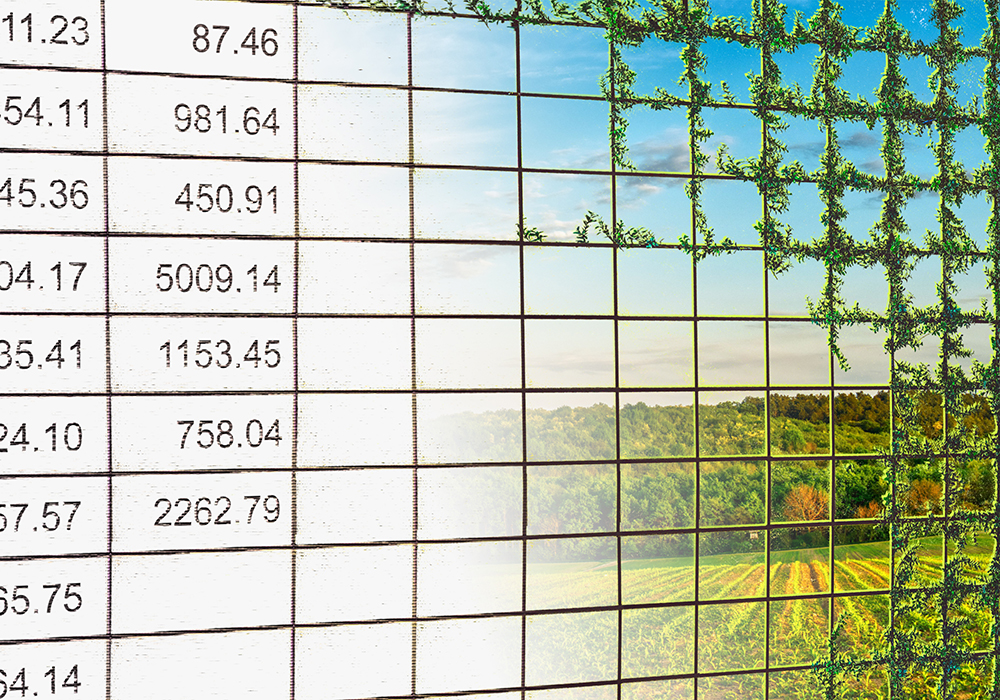

I can’t stand this job any longer. Spreadsheets every day, moving data around in little boxes. I need to look at something greener than Excel.
So I answer the ad that pops up on one of the Workaway groups I follow on social media. I didn’t even find them, to start off; they found me. The internet knows what you need before you do.
Wanted: someone to help with a large organic garden and food forest. Will provide accommodation (rustic) and meals. No experience needed. We’ll teach you what you need to know.
Rosemary, elderberry, watercress, thyme
Currants as red as a sweet summer wine
It’s in a small town in the middle of nowhere. Not even a town. Mary picks me up at the train station and we drive for an hour. There aren’t any other houses around when we get to her place, just fields and cows and sheep. Some trees, too. I realize I don’t know one kind of tree from another, beyond a few basics like this thing’s an evergreen and that thing has leaves.
“Is this the food forest?” I ask as we approach the short brown house.
“No,” says Mary, pointing, “that’s the food forest.” It’s a lot smaller. The bigger forest was kind of just out there by the road, full of trees in lines like popsicle sticks. The place she points to looks more like a jungle, with bushes and tangles and vines and stuff. Some of them have fruit growing on them, and that’s about the only thing I can describe.
We get out of the car. I’m scared to go near the tangled vines, so I’m relieved when Mary, in her loose clothing and Birkenstocks, walks toward the house instead.
My deep breaths are interrupted by quacking and squawking. A line of ducks is waddling up to us, brown and white. Chickens follow behind them and even a big peacock, an albino, with all-white feathers on display.
“Hello, girls,” Mary says. Right. She said something about helping with the girls in my phone interview, but she clearly doesn’t have any real children. “Meet Ellie. Ellie, dear, these are your new friends.”
I wave at the birds. They don’t wave back, observing me instead with beady eyes.
Horse chestnut, witch hazel, ivy and bay,
Thunderclouds high on a summer’s day
I have a fold-out cot in a room full of seedlings, a word I’d never heard before which means baby trees in pots. I wake up that first morning and they’re surrounding me, green things staring from all sides. I blink. They’re not staring. Plants don’t have eyes.
Well, I soon discover, potatoes do. I help in the kitchen, cutting them off. They’re sprouts growing out of the potato, those little green knobby things yearning to turn into a plant. For some reason I feel sad when I throw them in the compost. Maybe they’ll grow out there.
Mary has me collecting eggs and feeding the birds, who lunge at the grain so fast you wouldn’t believe it. The chickens’ necks bob up and down. I can see how they’re descended from dinosaurs.
“Have you ever pruned a tree?” Mary asks. We’re halfway through the morning and I can’t say I have. She hands me scratchy gloves and something that looks a bit like scissors, only sharper. Curved, with a hook. Rooks and sparrows scatter as she shows me the ropes. I clip away bits of trees like I’m clipping someone’s nails.
“After tea, I’ll show you the fungi,” she says.
I’m sweating as we go back into the house. It’s rustic, like the advertisement said; kind of half house and half barn. My room is not the only one with things growing in it. Mary says she’ll move them from their pots to the garden later, although a few green things are sprouting and flowering in a corner that, as far as I can tell, come directly up from the floor.
The kitchen looks like a recreation display I saw when I visited a historic castle. The big wooden table has homemade bread on it. The chairs look like they’re made of logs. Bundles of herbs hang above the fireplace. It smells like bread and damp.
Mary makes tea out of leaves kept in a big cloth drawstring bag. I sit on a log chair. It’s way too big for me. It could probably have held King Henry VIII. The tea steams as it steeps. Mary spreads butter on lopsided scones. “How are you finding it so far?” she asks.
“Nice,” I say, a word inadequate for my first impressions.
“I’ve lived here for five centuries,” says Mary. My shoulders freeze in place. She smacks a palm against her forehead. “Silly me! Sorry, five decades. I always get those two confused. The tea must be ready now.” She hands me one of the two brown pottery cups. As the first sip crosses my lips, I wonder whether to believe her. Or if she’s all there.
Carrots for caring, potatoes for peace
Lettuce for letting go, kale for release
The organic garden sits behind the house. Feathery carrot leaves and bushy potato leaves poke up beside stalky broccoli. I recognize one thing – tomatoes, and that’s because they’re sitting on their plants, all red and shiny. Gooseberries hang in striped green globes from their branches. Mary shows me how to pluck them properly (I wouldn’t have guessed they had a method, or maybe it’s just Mary who does), hands me a bowl, and heads back to pruning.
It’s slow going, seeking out green among green. I pick around the thorns, but some still manage to prick me. Unscathed by stickers, white and purple butterflies flap past. Birds have a little rap battle. I suppose, once a bowlful is picked, we’ll eat them?
The garden is capacious. I wouldn’t have known, from first glance, that it was so big. Vegetables, fruit, bushes. Insects crawling around. Some good, some bad, apparently, though Mary wouldn’t put it in terms so black and white. They’re all following their own design. It’s just that some match the plants’ designs more closely than others.
“Done?” pipes a voice behind me. I jump. There’s a shadow there. No, it’s only Mary. I hadn’t expected her back so fast. I hadn’t heard footsteps at all.
“I guess I could be done,” I say, though there’s still room in the bowl and my fingers are bleeding. She doesn’t remark on that.
“That will do,” she says. “Let’s take them back to the house and head over to the logs.”
The logs?
It turns out that’s where the mushrooms grow. Mary drilled little holes in some logs and planted them there. Some look like little shelves sprouting out. Some look like brown and yellow wrinkles. Some aren’t too different from what I’d find at the grocery store, only wilder looking. They stick out of the logs like far too many ears, nature looking unnatural. I shiver a bit. It’s hard to imagine eating them.
“What you see is only the tiniest part of the fungus,” she explains. “Most of it is mycelium. It’s kind of like roots. Think of it as a network growing underground, or inside the wood. Sometimes, in the forest, the tree roots give some of their fat and sugar to the mycelium, and the fungi help the trees get water and nutrients that are out of their reach.”
That’s very kind of the trees and mushrooms, but I’m sitting here thinking of a giant tangle of roots inside those logs.
“We keep these by the shed because it’s cool and shady,” Mary explains, “and we water them regularly from the stream. You can help with the watering.”
I go over to the stream, a small trickle half-buried by the fronds of the food forest, and fill the watering can. I clumsily water the logs, telling myself it doesn’t matter if I spill some because it’s just giving extra water to the grass.
Woodlands, wildlands, take your pick
Rhizomes, log homes, roots so thick
I’m weeding the rhubarb patch when I feel it. Something inside me that isn’t me. A niggle, a wriggle in the center of my chest. I stop moving, worried that something’s wrong. A heart attack? I think wildly. But this doesn’t match any of the signs I’ve read about. I just feel… weird.
There’s the regular, everyday me. There’s that squirmy feeling. And connected to that, there’s a circle outside that’s expansive and wriggly at the same time. Some part of my consciousness extending beyond my body, digging into the ground.
It feels like I’m drinking water through my skin.
I close my eyes. I open my eyes.
An inquisitive chicken peeps at my feet, jolting me out of it. It’s half grown, not quite a chicken and not quite a chick, as gawky as any human teenager. It wobbles around on stalk legs.
I get back to weeding and try to forget what I felt.
I pull out yellow flowering plants and thick wild grasses, putting them in the wheelbarrow to take to the compost bin. The rhubarb has giant leaves and green-red stalks, making it easy to tell apart from everything else. My hands stay busy with the soil and the pulling, but my mind remains occupied with turning that feeling over and over.
I’m not sure whether to mention it to Mary or not. It’s a few days in and she seems nice enough, if a little eccentric. She showed me a plant called sticky willy that sticks to your trousers like Velcro. You can eat the seeds, but they don’t taste very good. We got into her store of home brew, and I’m not sure exactly what was in it, but it got my head spinning. The walls turned purplish and I heard rattling noises in there, only to wake the next morning to off-white walls again, wondering if I’d dreamed all that.
I mention nothing. I almost forget. The next day, I’m out in the food forest when the feeling returns. Under the trees, light comes down in patterns. Inside my chest, the same patterns bloom. I can’t see them but I feel them. The sunlight pours inside me and I drink it.
Raspberry, rosemary, remember, forget
You know yourself but don’t know who you are yet
Something’s going on. Something older than me. Ancient compared to five hundred years, even. Something bigger.
I feel the wind before I wake. I walk in the woods and sense the roots beneath the ground, extending down and back and intertwining.
Half of me wants it to go away. I’m terrified of this vastness that pulls beyond anything I’ve known. I want to be me again, looking at spreadsheets and watching movies at night while eating terrible pizza. The other half wants it with the same craving I have to scratch an itch. I went on this Workaway to get away from “me” after all.
Two days left and I water the mushroom logs. I feel moistened as I moisten them, fed as I feed them.
One day left and I still haven’t told Mary. I eat my cereal and see the fields of wheat that made it. I feel myself swaying to and fro.
Ten minutes left before we leave for the train station. I feel the peacock acknowledging me as I tell it goodbye. It doesn’t understand hellos or goodbyes in the way humans do, but it looks and sees into me with those dark, wary eyes, and the thing inside my chest dwells equally in its breast, and we’re one thing looking at itself.
Rooted in earth, sprouting above
This is rebirth, your only true love
Back at my desk, I touch the wood my computer sits on. I don’t feel much from it. Sunlight filters through the window. Spreadsheet time. I pour myself coffee.
“Hi,” says everyone. “Did you have a good holiday?” Smiles all around.
This is normal, right?
The numbers I’m working with connect like roots. The internet reaches deep. I watch screens lighting up around the world and let that light settle within me.
I can’t bring myself to watch TV that night. I make myself a salad. The lettuce and carrots taste of the soil that grew them.
I have to move. I put on my dirty boots and walk.
The closest forest has never felt close before, but an hour of sidewalks takes me there. I might be walking faster than I used to.
I step under brown and green branches. It’s like letting out a breath with the lungs of the globe.
The woods stretch into town, through every scrawny shrub and dandelion poking up through concrete. The roots go all around the world. The fungal networks connect far deeper than the little white tufts I see.
I’m in this world and I’m all of it.
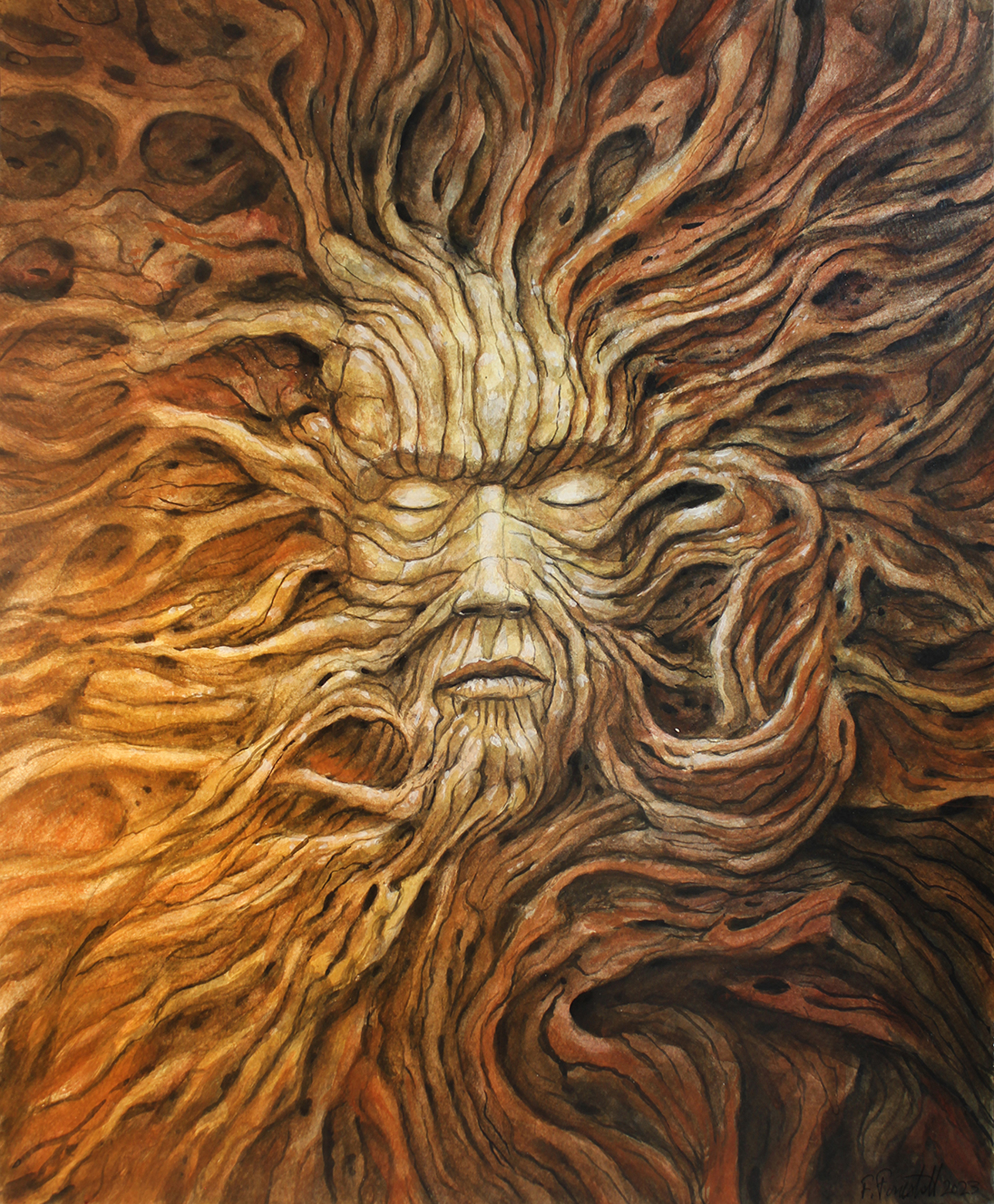
A figure extends from a tree, a giant ruffled fungus. I blink and it’s a woman. Blink and it’s a fungus again. Blink again and it’s both.
Her feet are bare, her smile serene. For a time, I called her Mary. She looks at me with acknowledgment: one thing looking at itself.
“Hello,” she says. “I’ve been waiting.”