The doorbell rang just after noon.
“A man,” the office said, “about forty-five years old. Does not look like a broker or a preacher.”
I minimized the movie series window and checked the stream from the camera installed on the corner of the building. The visitor stared straight at my agency’s sign and spoke to the door.
“Calls himself Mr. Duner,” added the office. “Says he wants to ask some questions about Heavens. Complete school education. The accent suggests Idaho or Wisconsin. Rather, Wisconsin based on indirect signs. Appears to be a farmer. Healthy. The probability that this is a client is only twenty percent.”
I brushed the crumbs off my suit and put the half-eaten sandwich in the top drawer of my desk. On a good day, it wouldn’t be worth interrupting lunch for the sake of twenty percent, but there had been no good days for a long time.
“Let him in,” I told the office, and got up from my chair, “and set up a moderately religious interior and cathedral lighting.”
In the time it took Mr. Duner to wipe his feet on the rug and fiddle with the doorknob, the office had finished preparation, and I had positioned myself between my desk and the entrance.
The visitor turned out to be about my height, but bulkier. Graying hair cut short, a high, tanned forehead, the look of a man who is self-confident, but not defiant. New, good quality clothes; a plaid shirt with a red W embroidered on the breast pocket peeking out from under the open jacket. I mentally kicked the office – “indirect signs,” smartass.
I said hello and extended my hand. Mr. Duner returned my greeting without hesitation and allowed himself to be escorted to the visitor’s chair. As I walked around the desk to return to my seat, Mr. Duner studied the poster behind me. There, specifically for him, an advertisement for Disney cruises in a Protestant region of Heavens was displayed.
“If you would like to see how things work there, I have a discount for special partners,” I remarked. “Or, if you prefer, I can offer you a tour of a more traditional version of Symeon the Theologian – a garden alive with every good green thing. A world of flowers and sweet-scented lilies, and innumerable birds. The fire is unscorching.”
“Actually, this is exactly what I wanted to ask you about,” Mr. Duner replied. “Not the fire, of course, but the birds. Where do they get there from? Do birds go to Heavens?”
I cleared my throat and smiled broadly at Mr. Duner. A farmer on vacation whose route had taken him through Chicago. Chances were he was just looking to chat out of boredom. My office was close to Union Station and occasionally I had visitors who were looking for a diversion while they waited for their train.
The problem was that trains could go to and from anywhere and, as it happened, random passengers might have entertained the idea of killing something else besides their spare time. Like somebody. For such cases, I kept a taser in the same drawer where I had just hidden my lunch. But I would rather pull out a sandwich, not a weapon.
“No, of course not,” I replied, adding a note of solemnity to my voice. “Birds of the earth are dumb creatures, devoid of the divine spark. The birds that inhabit Heavens have been there since their very creation.”
I may not have been doing very well in recent months, but I am an old hand at afterlife insurance. Neither a religious fanatic nor a techno-maniac would find any fault with such a wording. That’s the gist of it, no matter how you look at things.
Grinning from ear to ear, I kept my eyes on the visitor. I was well aware of what the satisfaction of hearing the “correct” answer looked like. But instead I saw something else on Mr. Duner’s face; perhaps doubt.
“I may be from Wisconsin,” he said dryly, “but I haven’t been to church in over thirty years. And I have a good idea of Heavens’s true nature.”
That was doubt indeed – the doubt that he had approached the right agent. I immediately changed my expression to one that was both understanding and skeptical. The office had probably already flagged Mr. Duner as a hopeless case. But I was not going to let him leave without at least trying.
“They are only virtual environments for consciousnesses uploaded on the brink of death,” I said in my usual voice. “Or, by personal choice, at any moment of life.”
“At the last moment of life,” Mr. Duner interposed.
“Of course,” I confirmed. “Creating a copy destroys the original, although believers consider this the moment of the Ascension of the immortal soul.”
Mr. Duner nodded, then leaned back in his chair and glanced around my office again.
“You took me for a redneck,” he said calmly, gazing at a poster with a quote from the Book of Mormon.
I shrugged. Everyone makes mistakes.
“But I am a redneck, so I have nothing to be offended by.” He flashed a smile showing yellowish teeth, and grew serious again. “So what about the birds in Heavens?”
“They are scenery, props, as is everything else there. Lions and lambs for Christians, Valkyries, ancestral spirits, Pokémon, elves, and aliens for everyone else. There are, of course, exceptions…”
“Like what?” asked Mr. Duner, immediately intent.
“Sometimes, a person after death tries the body of a virtual animal. Or, say, a Pokémon, or an elf, and so on down the list.”
“Aah…” he drawled, disappointed.
I felt it was time for me to take the initiative, to increase my chances of getting a client. “Why are you so interested in birds, Mr. Duner?”
He hesitated.
“I don’t really care about the birds at all. I asked about them only because you mentioned them. Actually, I want to know about dogs.”
Animals again. For a passerby who just wanted to spend some idle time chatting, he was perhaps a little too fixated on one particular topic. Usually onlookers jump from one question to another.
“About dogs,” I repeated, and nodded, showing that I was ready to listen to him further.
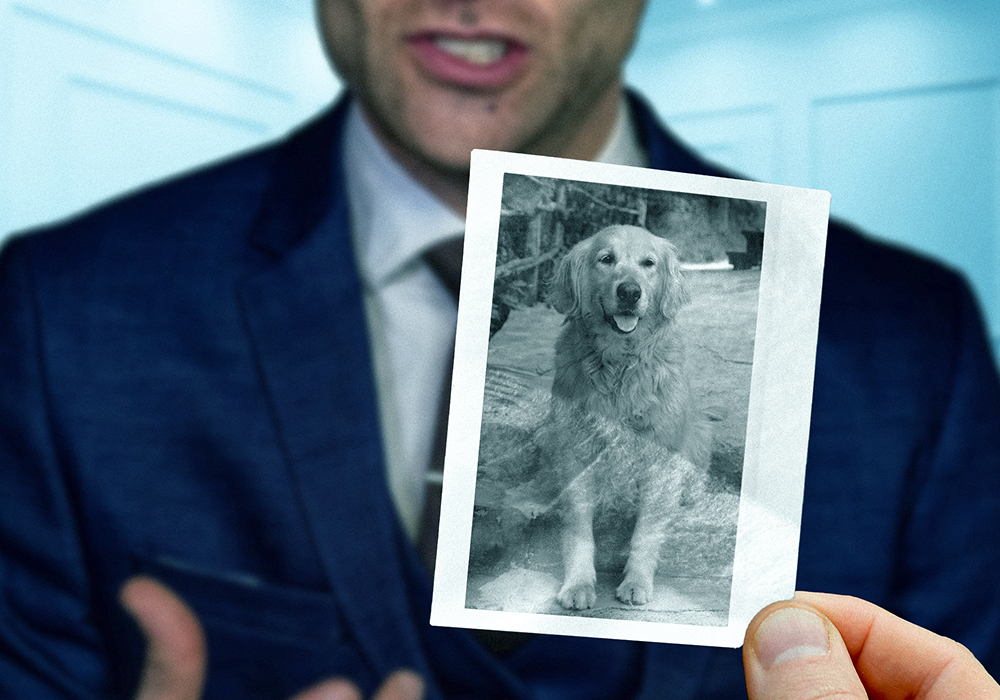
“You see,” said Mr. Duner, “I have a dog, Jack, a very old chap. I wondered if it would be possible to arrange an Ascension for him, so that he would not die, but go to Heavens? And… and wait there for me.”
I had heard some version of this so many times. Clients who want to have a virtual copy of the house in which they spent their childhood, or their first car, or a beloved pet parrot. I can make money on this just as well, although not as much.
“When you get to Heavens, your dog can be recreated there from photos and videos. Or based on a sample of his DNA, for example from a tuft of fur. We can draw up a contract for your Ascension in such a way that—”
“But it won’t be my Jack,” Mr. Duner interrupted. “It will just be a virtual dog that looks like him. How did you put it – scenery? And Jack is my friend, a true friend.”
I opened my mouth to spin him the usual fairy tale about virtual companions behaving just like real animals, and how he could raise his Jack again, or even keep him as a playful little puppy forever, and how they would spend many earthly lifetimes together – but caught myself just in time. I had already underestimated him once. If I made that mistake again, he would simply get up and leave. And all that would be left for me tonight would be a sandwich and a movie series. And maybe for tomorrow too.
“The Ascended change,” I said, “sometimes beyond recognition. A person could think that all he needs from the afterlife is to endlessly sit on the porch of his house, nursing a can of beer, listening to the radio, and watching the Badgers game on Saturdays. But when he gets to Heavens, he realizes that all this bothered him to death during his lifetime already. He recalls that he wanted to learn how to play the violin when he was a child, or read the Iliad in the original. His old friends, both living and Ascended, turn out to be complete strangers to him.
“Your Jack – assuming, of course, that he could be uploaded – may simply not be needed by you anymore. You will be able to talk to angels, or feast in Valhalla, or walk around the world, or dedicate your afterlife to deciphering the signals coming from that star that was all over the news last year.”
My visitor raised his eyebrows.
“I can understand angels,” he said. “But aliens? That’s a little different from what they told me in Sunday school.”
I rummaged through a stack of promotional brochures, pulled one out, and slid it across the table to Mr. Duner.
“The soul’s progress never ceases,” he read, leaning forward and squinting. “It goes from beginning to beginning through beginnings that have no end. Saint Gregory of Nyssa.”
Mr. Duner leaned back in his chair again.
“I have no doubt that clergy can find a suitable quote for anything. But in reality?”
“The reality, of course, is more prosaic. Every mind has a degree of neuroplasticity. The code that Ascended become is likewise endowed with some capacity for change. Otherwise, the Heavens would resemble a museum filled with exhibits sealed in glass.”
“I see,” he said, with the hint of a smile. “But I never wanted to play the violin. I suppose that for most of the dead football on Saturdays is enough. And I don’t flatter myself by thinking I’d be an exception.”
I chuckled. On the one hand he was right, of course. Even when the Heavens were very much like Utah in terms of demographics, power usage on the server farms surged when the football season kicked off and dropped back down after the Super Bowl. Conversely, the Heavens were moved to the Moon precisely because some people changed too much after their death, and caused inconvenience to the living.
Despite meticulous laws restricting the Ascended’s influence on the ordinary world, loopholes persisted. At first, communication with the Heavens worked both ways, and was not much different from the network connection between, for example, Chicago and Paris. Yet, satiated with posthumous leisure, quiet Mormon ladies transformed into furies and harassed on social media those who offended them while they were alive. Decent parishioners became hackers, seeking vengeance on corporations that had fired them twenty years ago, or even entire countries that had wronged their forebears. And that wasn’t counting the Ascended who revealed actual criminal tendencies. Attempts to isolate the Heavens from the global network had failed while it was terrestrial. The second and a half of signal delay between the Earth and the Moon had turned out to be the most reliable protection. Every exchange became a slow turn-taking conversation, giving firewalls enough time to do their things.
“I need my Jack,” Mr. Duner went on. “Not some other dog, not a virtual friend, not a saber-toothed tiger, not a personal cherub. Jack and I have been together for twenty years, and I would give anything for…”
He hesitated for a second.
“You should know that I have means. The government just bought my farm – a hundred acres on the border with Minnesota, with a freshwater stream and a patch of actual forest.”
I squinted at the computer screen as the office estimated the approximate numbers and barely kept myself from whistling.
“This should be enough to sign contracts for an eternal stay in the Heavens for you and your entire family.”
“Jack is my entire family. I took him home when he was a tiny pup and fed him with a pipette. He brought me squirrels when I had no money for food or ammo. He kept me warm when I almost died from that damn South American fever. Every year I pay the state a lot of money for my old truck because Jack likes to ride in it.”
“Diesel engine?” I asked.
“Gas,” Duner answered with a hint of pride in his voice.
“Wow,” I blurted.
Mr. Duner shrugged.
“So, rest assured, I can pay. If you only know a way.”
Something in his tone made me uneasy.
“Why did you come to me, Mr. Duner?” I asked.
He blinked.
“I… um…”
“You’re not going on a train journey, alone, without Jack. And you didn’t roll up to Chicago in your gas-powered monster to stroll along Michigan Avenue and to visit the random offices of insurance agents.”
“I have a new car too,” Mr. Duner muttered, lowering his eyes.
“Very good,” I said, “but why did you drive it so far?”
“Well,” Mr. Duner drawled, still staring at his hands, and then fell quiet.
I realized that he was going to lie to me now. And that he could be dangerous, although not in the way I’d first thought.
“Office,” I called aloud, rising from my chair, “Mr. Duner is leaving us. Tell the door to lock behind him. I’ll have a lunch break. And turn on the normal lightning.”
The pale ethereal glow ceased to stream from the ceiling, and all the solemnity I had seen in one of the old Catholic temples in Spain was gone. For a business conversation with a client, an appropriate interior and the right ambiance mean a lot. And a demonstrative rejection of them, too.
But Mr. Duner continued to sit, staring downward.
“A year ago,” he said softly, “Jack had cancer. I took him to the university clinic in Madison. Meanwhile, I started asking around if they could arrange an Ascension for Jack. Everyone sympathized and suggested that I clone him. Silly people. But there was one doctor… you see, I paid quite a bit of money to be with Jack the whole time he was in treatment. And afterwards I made a generous donation to the clinic. They knew me there, they knew where I came from and what I was looking for. So, well, she told me…”
He fell silent again.
“Mr. Duner,” I said, “if some random doctor told you I could arrange the Ascension for a dog, then she lied or made a mistake. I don’t do stuff like that. And no one else does, either, believe me. Inspectors from Salt Lake City and Burbank strictly enforce regulations for the use of Ascension equipment.”
Mr. Duner looked up at me.
“Her name was Marjorie Torres. She told me that you used to work for both the Mormons and Disney, and that you detest both of them.”
I sank back into my chair. On the computer screen, on top of all the other windows, there appeared a photo of my visitor with a large dog that looked like a Labrador in his arms, and a long screed of text. What Mr. Duner had mentioned about himself was enough for the office to have assembled a complete dossier. My visitor was precisely who he said he was: Kenyon Duner, forty-six. Born in Idaho. At the age of seven, his family had moved to Wisconsin. Served two years in the Navy, only taking leave once, for his parents’ funeral. Graduated from Agricultural College and bought a farm.
No mention of the Brigham Young Institute or The Big Mouse. No ties to extremists.
I scrolled through the report to the very end. The probability that this is a client is 85 percent.
Mr. Duner still sat there, biting his lower lip and clutching his knees with his fingers.
“Would you like something to drink?” I suggested.
“Water, please.”
I got up and walked to the back of the office to the fridge.
“Do you know who was the first to Ascend to Heavens?” I asked, handing Mr. Duner a bottle and a paper cup.
“The Reverend, what’s-his-name, and that mathematician girl who was hit by the car,” he replied, releasing his knees.
“Nope.” I cracked the cap of my bottle and took a swig. “The first were three saimiri monkeys. Able, Baker, and Chang. The final version of the Ascension procedure was tested on them. Monkeys flew into space before humans did, and they were the first to survive their own death.”
Mr. Duner took a sip of water and looked into my eyes.
“But how did researchers understand that everything had gone as it should?”
“All three knew their names. And Able could use sign language. Once uploaded, they were put into a simulation lab where we— where they were studied. At first, they grew excited when they heard their names. Then they recognized each other and the avatars of people familiar to them. Later, they were transferred to other simulations, other regions of Heavens, and tested thoroughly, multiple times. Their intelligence, memory, and behavior were examined for a full year. It was only after this that Reverend President Reeve chose to Ascend himself.”
I put my bottle of water on the table and stepped to the window, turning my back on Mr. Duner.
“What happened to the monkeys?” he asked.
“Baker died a second time,” I replied without turning around. “A critical fault emerged in the third month after upload. Able and Chang were erased a year later. It was deemed repugnant to allow some dumb creatures to be saved before the reverend president of the great church, which had invested most of its fortune in the creation of Heavens, after all.
“Finances, of course, were also considered. The first simulation servers were worth more than their weight in platinum. Then it became clear that completely virtual companions are much cheaper than copies of consciousnesses. They were easy to create and didn’t require a large amount of computing power. Frankly, most people don’t see the difference between a truly Ascended animal and a program pretending to be their pet. And Heavens, Mr. Duner, is a business with enormous overheads, especially after everything moved to the Moon.”
The visitor’s chair creaked behind me; the farmer’s heavy boots took a few hesitant steps.
I turned around and found myself face to face with Mr. Duner. His breath smelled like mint toothpaste, and his eyes were pleading.
“But you can help my Jack, right? You do know how to?”
“He’d be bored without you, out there, alone,” I said. “Animals don’t have football on Saturdays, and they don’t usually dream of learning Ancient Greek. Jack won’t have a gas truck front seat to ride in, and no real squirrels to chase after, just cheap fake toys. He will be the loneliest dog on the Moon. Is that what you want for him?”
Mr. Duner took a step back.
“But I could pause his simulation, right? I heard that some dead people do that – they fall into a very long dream, so that they can see the future sooner.”
Or wait for the new season in their favorite sport.
“It’s true,” I said, nodding, “but you may forget about him by the time it’s your turn. You are not elderly, Mr. Duner. With all the money you have, you’ll have a comfortable lifestyle for the next fifty years. Or even decide to skip Heavens after all. Not everyone, you know, is eager to exist forever.”
He lowered his head, and then, as if remembering something, straightened and looked around, surveying the walls of my office. Finally, his eyes fell upon a Disney cruise poster.
“You and I will sign another contract,” he said slowly, “for regular visits to Heavens for tourism. I’ll buy or rent everything I need and I’ll keep coming to Jack. Wherever I may be for the next fifty years.”
He was staring at me again, and now his eyes were glowing.
“The delay to the Moon isn’t that bad, is it? It doesn’t prevent living tourists from communicating with the Ascended, right?”
Now Mr. Duner looked exactly like my ideal client. Even without seeing the screen, I was certain that at this moment the office had rated him as a 100 percent prospective service buyer.
He also looked like his life depended on my answer.
“It doesn’t.” I shook my head.
Mr. Duner took several deep breaths.
“You know,” he finally said, “Jack likes to howl at the full moon sometimes. And now I will look at the sky and know that he is there. If you’ll really do it…”
For an entire minute, we stared at each other in silence.
“Well,” I prompted, “let’s go back to my desk and talk about the fine print. All payment, for obvious reasons, will be made on a cash basis…”
In the evening, when I stopped by to visit Purrcellus, I told him about Mr. Duner.
“Why did you lie to him and say that Able and Chang were erased?” he asked when I had finished.
“They would have been,” I replied, “if Marjorie, Tom, and I had not hidden them on the test server.”
“Did these people love animals as much as you do?”
“Only Marjorie.”
“What about Tom?”
“Tom was a devout Mormon. He believed the books of an oddball named Joseph Smith, who wrote that animals can be saved after death just like people.”
Purrcellus snorted.
“Still, why did you lie?”
“A little bit of desperation,” I said, “is always good for business. Despair and hope.”
“I don’t get it,” he admitted.
“Doesn’t matter. Let’s just say that you, Able, Chang, and all the rest have to be paid for. And Mr. Duner had money he was willing to part with.”
“So you took all his money?”
“No, of course not. But it was a wonderful deal for me.”
Purrcellus snorted again. He is very intelligent, but some things, like how to properly conduct business and the concept of money, elude him.
“And you didn’t mention that animals can change after their deaths, too.”
I shrugged.
“Everyone can, but not everyone wants to. When Mr. Duner asked me about the aliens, I told him that the Heavens aren’t a static simulation. A mind freed from the limitations of a physical body might evolve in any direction. And then old dogs learn new tricks, and old tomcats like you get chatty and turn into a bit of a bore.”
Purrcellus thought for a moment and cheshired around the room.
“You’re too cunning,” he concluded.
“Well, I am an insurance agent. It’s a mandatory requirement for my job.”
He laughed in his peculiar way, sounding like a coughing rat.
“I’ll look after this Jack when he gets here, okay? So that he won’t be scared at first.”
“Only from afar,” I warned him, “or at least turn into someone else. I don’t know how he feels about cats.”
“You’re funny.” Purrcellus yawned widely, showing a pink mouthful of small sharp teeth. “What can a dog do to me here? I’m the one who can ruffle his fur.”
“That’s what I’m afraid of.” I chuckled.
He was silent for a while, then climbed onto my lap and purred. I stroked his ears until his eyes began to close.
“Are you coming tomorrow?” he asked dreamily, curling up into a ball.
“Go to sleep. Of course I will.”
I thought of Mr. Duner.
“Tomorrow,” I added, “and every day for the next fifty years.”