Back in the 1980s, if you were a horror fan, and of a certain age – say somewhere in your teens – and unless you were especially dedicated to searching for interesting obscurities from the genre, your options, as far as variety was concerned, were limited. The back cover plot synopses could not be more general. Usually, they would describe a group of kids, or perhaps one loner kid, stumbling upon evidence of some ancient evil buried deep within the twisted history of their small town. It was very frequently a small town, or anyway the suburbs. What that ancient evil and twisted history were, well, you’d have to read the book, which was often called something like The Needing or The Sundering. The pisser, quite often, was that the specifics of that evil and that history were often as general and rubber-stamped as specificity is capable of being.
While there were some more extreme and lightly subterranean attempts to subvert that kind of thing, like the splatterpunk movement, those tended to be if anything every bit as juvenile as the other stuff. Which isn’t to say it was all bad; in the mainstream world, Stephen King hit a few home runs back then, and the late Dan Simmons’s novel Summer of Night is an excellent example of the idea of kids encountering ancient evil in their town done really well. In the more subversive realms, there were guys like Karl Edward Wagner doing really unusual things with horror.
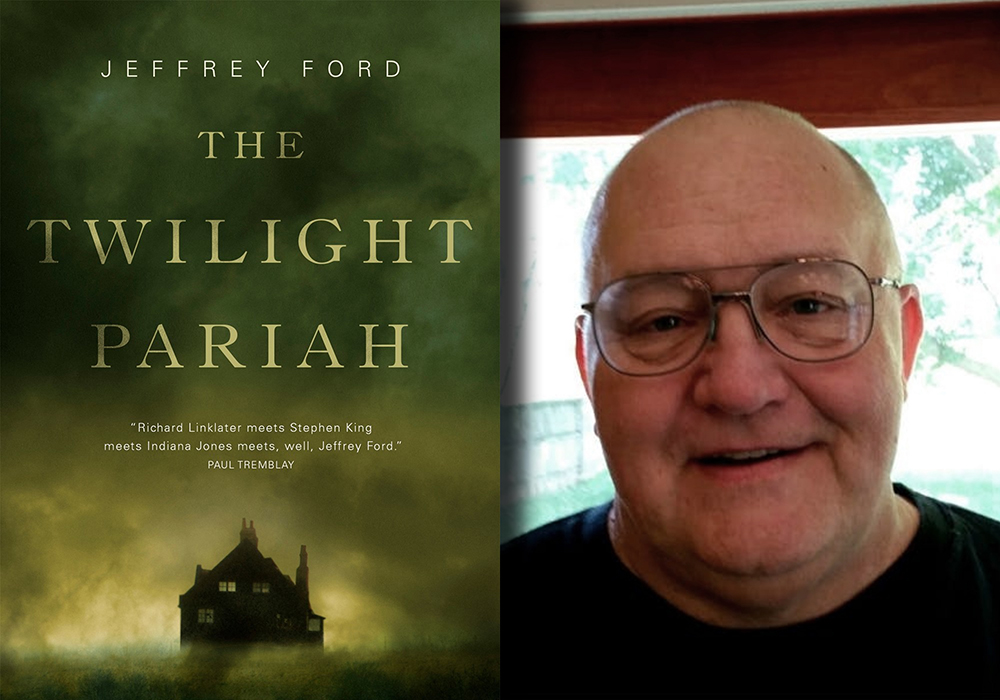
But if it weren’t for those rare victories, I might have bailed on the genre, and I rarely go back to that era of horror’s boom years, because I became tired of it always being about kids or teenagers. It felt like something to grow out of. Further, while I’m not immune to nostalgia, I do distrust it. So just imagine my dismay when I found myself getting into such a novel, though a relatively recent one, called The Twilight Pariah by Jeffrey Ford.
Ford has been around a long time, is a celebrated writer of horror, fantasy, and science fiction, but this is my first experience with his work. The gist is this: it’s some time after high school, and our narrator, Henry, has returned home to watch over his father, who, since the death of Henry’s mother, has become a strange man, addicted to old horror and science fiction movies that apparently play on some station in their town all day long. While home, Henry also reunites with his two best friends. Russell is a huge football lineman type, and gay. Maggie is flighty but has homed in on what has become her abiding interest in life, which is archaeology. There is, of course, an old house outside of town, which was once the home of a prominent family, though it has now fallen into disuse and dissolution. Maggie is convinced that some interesting remnants of the strange place must be concealed somewhere on the grounds, and she recruits Henry and Russell – as well as, from time to time, Russell’s boyfriend, Luther – to help her dig. Which they do, with only half-hearted complaints. Conducting an amateur archaeological dig is against the law, so they go only at night, and cover their tracks.
Unsurprisingly, there is much that is strange about the house. It seems, at times, to be inhabited by somebody, but the last known member of the Prewitt family should have died decades ago. Yet late in the novel, when the group is exploring, Luther finds milk in the refrigerator, sniffs it, and notes that it’s fresh. Henry’s reply is “I can’t tell you how disappointing that is.” More importantly, though, are two things they find when digging where the property’s outhouse used to be. Buried there, they find an old bottle, with a little bit of red liquid, labelled Kind Nepenthe. It’s discovered that this potion, whatever it is, was created a long time ago by a man named Dr. Robert Anchill. The other thing they find there is the skeleton of a baby, a baby that appears to have had horns, and possibly a tail.
As these discoveries obsess them more and more (especially Maggie, who researches all of this relentlessly), dreadful and horrific violence begins striking people in town, people they know. These murders resemble a series of murders from decades ago, which were attributed to a serial killer known as the Twilight Pariah.
I’ll cut to the chase here, because while a lot of this probably sounds pretty standard issue, in that 1980s/90s horror fiction kind of way I described earlier, where it goes is fairly interesting. For one thing, there’s the kind of metafictional element of Henry’s dad, grown absent-minded in his bottomless grief, finding the only escape hatch he can in old horror films. Henry regards this as unhealthy, and pitiful, which it is. What’s interesting about it, though, is that The Twilight Pariah does read as a conscious throwback. That demon nostalgia, again. But there’s a knowingness to what Ford is doing. When they all come to the reluctant realization that the menace they’re facing is supernatural, and Maggie explains what she’s learned, and about a piece of paper she found that says only “The Demon Mind” on it, Luther and Henry both laugh. Taken aback by their flippancy in the face of this horror, Maggie questions them, and Luther just shakes his head and says “It’s ridiculous.” He believes it’s all true, but it is ridiculous.
More interesting is when Maggie finds a book, written by Anchill, within the Gutenberg Project. It’s a chronicle of his work as a doctor, his invention of the medicinal Kind Nepenthe potion, and the reasons he invented it. Essentially, the woman who is living in the old house, and who should be dead, is not. I won’t get into why she’s still alive, but Ford includes several pages from Anchill’s book, which tells about how this woman, when young, witnessed a man being cruel to his dog, beating it just because it got tangled in its leash. Her horror at the sight stems largely from the fact that the dog can’t possibly know why it’s being beaten. It doesn’t understand. This haunts her forever, she can’t shake it from her mind, she keeps returning to it, feeling the horror and distress and the needless abuse, years after the fact. She consults Dr. Anchill because something, some demonic spirit, has risen out of her, from her head, and it is the Twilight Pariah, not some inhumane human being. She is also pregnant, and believes that this demon has possessed her unborn child. You can see where this is going.
I found that idea very powerful. I imagine most of us, especially in the internet age, has seen some picture, or video, or perhaps are unfortunate to have personally witnessed, something that they wish they’d never seen, that they would purge from their mind if they could, but can’t, and it returns, again and again, into their mind. I know I have. You don’t have to search for this stuff. If you hang around long enough, you’ll see something that will ruin at least some small part of you. Hopefully small. The way such images can affect a person becomes The Twilight Pariah’s source of horror and made sense to me. The fact that the horror genre traffics in such imagery (the crucial difference being that in those cases, the imagery is fictional) ties in as well. And it’s important that the old woman is not the evil being. The casual, off-hand cruelty of some stranger many, many years ago is. I must say, this is, in my experience with the genre, a unique and strong idea.
The Twilight Pariah isn’t perfect. After the reader has had everything laid out for them, characters will often repeat it, in sequence. In one case, Maggie just says everything we’ve just read – not the underlying themes of metaphors, just the facts of the case, as it were – prefacing it all with a kind of Isn’t it weird that… phrasing that made me wince. Worse, later on, some of those themes and metaphors are actually stated. It’s clearly unnecessary, and while I have no idea if this is the case, I am not speculating or accusing, but those passages read as though an editor, or editor’s assistant, inserted them because they didn’t think readers would understand the very clear story they’ve been told. It doesn’t feel like it organically belongs with the rest of Ford’s writing. In these moments, The Twilight Pariah reads like maybe it was intended for, or was jury-rigged into being, a YA novel.
By the end, it also feels like this was intended to be the first in a series of adventures for this group of characters, but a second novel has yet to materialize (The Twilight Pariah was published in 2017). Even so, I came away from the novel impressed by its strong, central idea, its somewhat ironic approach to recreating the feel of those 80s horror paperbacks. A better book could have been written with that core, but as a good one was written, I can’t complain too much.