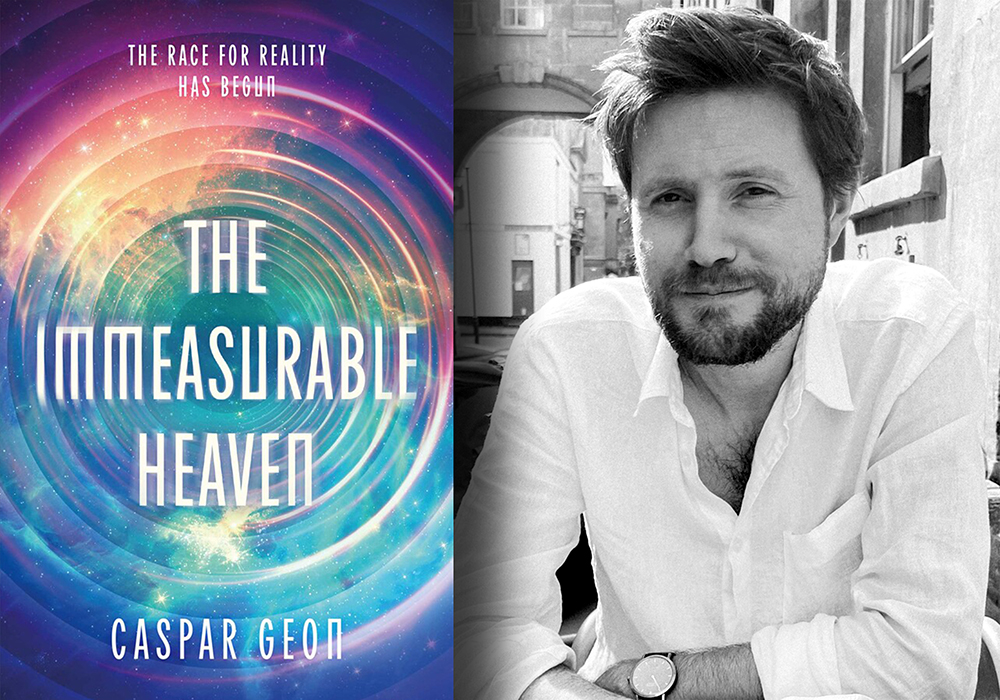
Caspar Geon’s The Immeasurable Heaven feels not so much like a story as a grand feat of imagination: a three-hundred page narrative workout session; a mental half-marathon for escapists, utopians and dystopians, philosophers and daydreamers. This isn’t a novel of ideas, however, its prose is vibrant but not particularly experimental. Nor should this introduction suggest the lack of a plot: in fact, the novel has two, converging toward each other from an intriguing distance. One plotline is bathed in a dark light, a tale of exile, hubris, and revenge; the other is a warmer tale of intergalactic travel with not insignificant tones of Douglas Adams, if not Terry Pratchett. They are both compelling, fast-paced, and rich in twists, betrayals, action.
Yet the sheer act of visualizing a single scene on any page of this novel requires more than your average dose of imagination.
The Immeasurable Heaven is set in a universe that could hardly be more alien. Instead of humanity, the novel’s characters belong to an endless array of species that have colonized the galaxy of Yokkun’s Depth and travel across it to trade and interact. Many of them are humanoid, but not all: one of the book’s most memorable characters, Gnumph, is a sentient spore that swells up to vast dimensions and can, in that form, travel through space. Most of the other characters spend the book inside Gnumph.
Life in this galaxy is not just incredibly diverse, it is fundamentally different from how we conceive of it. Purely biological life has long ago given way to a hybrid compound of the organic and mechanical, a biotechnological future that doesn’t evoke cybernetics as much as magic. Around this galaxy float the Myriad, minuscule life forms composed of bacteria, machines, and microscopic creatures that (or who?) interact with the characters in ways that are sometimes helpful, sometimes mischievous, and largely inscrutable: think of fairies or trickster spirits. At the other end of the scale, the stars of this galaxy are occupied by colossal beings called the Throlk, artificial intelligences who, at some point in history, became the de facto Gods of this universe, imposing over it an ominous peace. War and violence are virtually absent from the galaxy (at least in their most direct forms) because anybody who simply attempts to hurt another being is immediately struck down by the Throlk, killed on the spot as if by divine lightning.
If the image of a motley cast of spacefaring passengers traveling on board a sentient spore – some of them invisible, some reasonably humanoid, some fairly inconceivable – doesn’t seem far out enough, then keep in mind that this is only the novel’s initial, most stable state, one where it doesn’t intend to remain for long.
While gory and deathly violence might be absent from the galaxy, people of all stripes still manage to act unkindly to each other. Yokkun’s Depth is located in what the locals call “the surface Phaslair”, established reality, the universe as they know it. But not the only universe they know. New realities (new Phaslairs) are created in uncountable numbers every second, opening up an ever escalating infinity of worlds, dimensions, universes. Travel to these lower, younger planes of existence is relatively easy; traveling back, however, is all but impossible. Thus the benignly brutal diktat of the Throlk can be subverted using “drop weapons”, arms capable of exiling their targets into a different universe, from which they will never return.
Add to this the fact that a good chunk of the book takes place inside virtual realities, hyper-realistic games where characters don the avatars of bodies other than their own, and keeping track of what a given scene should look like (how many limbs on the characters’ bodies, how many eyes, any horns or probosces) is enough to give the most seasoned sci-fier a headache. And The Immeasurable Heaven certainly offers a heady mixture of imaginative ideas, shaken up together and pushed to their breaking point. By right, it shouldn’t work: author Caspar Geon (who, like one of the shape-shifting, dimension-hopping inhabitants of his novel also has an alternate identity as Tom Toner) should have written himself into a corner. A story where violence is impossible risks having fairly little in the way of conflict – of story. A novel where the reader’s notions of its fantastical races, planets, and technology risks going out the window at the turn of a page should be very difficult to keep engaging.
The novel’s small miracle, then, is that it works in spite of all this: that tucked within all the mind-bending stuff there is a good core of genuine fiction to keep book going. Characters have goals – some lofty, some petty – that make them easy to root for. A lot of their concerns are surprisingly simple, even quotidian: reaching safety; opening up to someone they find attractive; dealing as best as they can with the gap between what is expected of them and what they know to be right.
The Immeasurable Heaven is a grand and ambitious novel, a tale of Gods and sorcerers, of impossible twists on unlikely trajectories, the perfect in-vitro environment to stimulate a certain type of scientific-philosophical inquiry: about the nature of tangible reality, for instance, or the danger that existence might be a simulation, a game within a game played by intelligences beyond our comprehension. But what’s inside the book that transcends these grand concerns is what makes it, ultimately, remarkable. It is a work in the grand tradition of British mind-bending science fiction, equidistant from the irreverent psychedelic worlds of Brian Aldiss and the zany alien crews of The Hitchhiker’s Guide to the Galaxy. Spacefarers who are not afraid of venturing far will encounter all sorts of astonishing surprises as they are dropped further and further into its universes.